
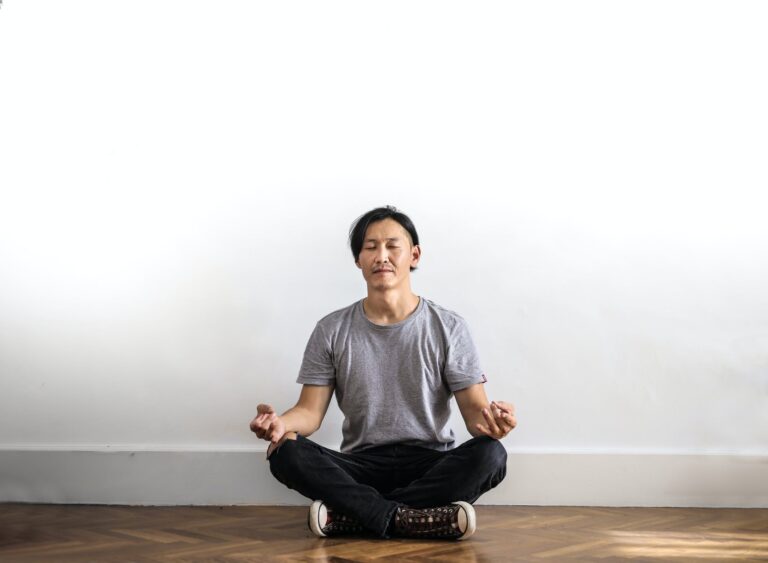
If it weren’t for the last few years of regular meditation, I’d be in a much worse state than I am. If you’re the kind of person who solves their life through self-realisation, you need something that keeps your inner balance intact.
Here are three ways to meditate in silence — no guided voice, no music, no background track.
New here? Start with The Reality Shift Template — my free 3-step framework for filtering the noise and creating on purpose.
Meditation is re-wiring — give it time

The whole thing turns on making it a habit. It’s the repetition that reshapes the brain — new pathways get laid down over weeks, not in one impressive session. Twenty years ago, telling someone they could physically remodel their own brain would have got you laughed at. Now it’s just what the evidence says: grey matter responds to what you do with it, and meditation is one of the practices that moves it.
The question I get most often is: how do I meditate, and what’s the right way?
If you’ve read anything on this before, you’ll have seen the standard answer — there’s no one correct method. That’s true, but it’s also unhelpful on its own. There are a few basics worth holding to:
- Close your eyes.
- Remove whatever’s competing for your attention in the room.
- Actually put your mind into it rather than half-doing it while thinking about something else.
Meditating without sound
Walking in the forest can be meditative and it works. Trimming a bonsai is mindfulness. Writing poetry can put you in the same state.
But all of that is aimed outward. You’re putting your mind onto something outside yourself and concentrating on it.
Turning inward is the entire reason to meditate in silence. Can you do that with nothing to hold on to?
When you give time to your inner landscape, a recovery process starts. Whatever noise and old thought patterns are sitting in there get to surface and finish.
It’s letting some steam out of the pressure cooker before the lid decides for you.
Think of the silence as sitting down and talking to a child while looking them in the eye — rather than being the cold, distracted adult who isn’t listening to a word.
How to meditate in silence: three methods
If you’ve never done this, one thing to know first:
Meditating with no sound to hold on to is hard at the start. You’re not used to giving your own head your full attention.
And if you’ve already half-decided meditation isn’t for you and won’t work, I have one tip that will guarantee you’re right about that:
Give up.
Fastest known route to no effect whatsoever.
1. Inner object focusing
The first method I really took to when I started was the empty bowl.
Sit cross-legged, comfortable, eyes closed. Then visualise this:
In front of you is a wooden bowl, big enough to hold in both hands. Dark brown. It has to stay empty. The only thing that can land in it is a thought coming out of your own mind.

Soft and quick — pick the bowl up and empty it.
Keep it empty. Focus on the empty bowl and nothing else. When another thought drops in, tip it out gently and set the bowl back down.
That’s the whole practice. It sounds too simple to do anything. Do it for two weeks and then judge it.
2. The breathing method
Breathing in and out is automatic. It’s also one of the few automatic things you can take manual control of, which is exactly why it’s useful.
Here’s the part that usually gets explained badly. Slow, deep breathing is not about getting more oxygen into you — at rest your blood is already close to fully saturated, and you can’t top it up. What a long, slow exhale does is engage the vagus nerve and the parasympathetic system: heart rate drops, blood pressure eases, and the body comes out of alert mode. That’s the mechanism, and it’s better than the myth.
It runs the other way too. Under stress your breathing goes fast and shallow, you over-breathe, CO₂ falls, and the vessels feeding your brain narrow — which is where the light-headed, tingling, about-to-fall-over feeling comes from. Most people have felt it and assumed it meant they weren’t getting enough air. It’s the opposite.
So: breathe deep and slow. All the way down into the belly, and make the out-breath longer than the in-breath.
You may feel resistance doing it. Keep going. Over time it releases the tension you’ve been carrying without noticing.
I’ve struggled with this myself. The freelance life doesn’t come with less work, and I’ve dragged a lot of stress around in my body over the years. Deep breathing is the thing that reliably slows it down.
3. Watching thoughts like clouds

Most people starting out assume the goal is a head with no thoughts in it.
Sorry — not happening.
You can slow the thoughts, the flashes of images and the general mental fuzz right down. You can’t delete them. Slowing down is the practice. And that spin-down of the everyday brain is usually what lets the deeper thoughts get a word in.
What I do is picture my thoughts as white clouds on a blue sky. My sky is windy, so they move through fast.
The clouds are the thoughts. Don’t chase them, don’t argue with them. Watch them go past. Let that be enough.
The one rule that decides whether any of this works
Whenever someone tells me meditation didn’t work for them, it comes down to the same thing. So here is the only rule that matters:
Begin, and never stop.
Carl set off walking towards his wonderful holiday destination. Then Carl stopped walking. Carl is now annoyed that he never got a holiday.
That’s genuinely all of it. Make it a lifestyle — daily, or weekly at the absolute minimum.
Because what you’re actually doing is remodelling your own brain, and that takes time. New pathways get laid down through repetition and nothing else. Slowing down takes time. Changing the way your body sits takes time.
Beginners expect an immediate, obvious result. You might get lucky. But don’t measure this after a week, and don’t underestimate what you’re up against — the pace this planet runs at, and everything else you’re carrying.
Don’t force it, don’t fight it
Make peace, not war.
Whatever turns up in your practice is you. Don’t fight your own inner self. Let it come.
As I said at the start: your mind isn’t used to being quiet, so let it scramble for a while. It’s taming a wild horse — you let it ride itself out until it settles and starts to like the arrangement. Don’t be the distracted adult who won’t give the child any attention.
Once silence works for you, it’s worth trying it the other way with sound. Here’s a YouTube track of Tibetan singing bowls and nature sounds to start with.
Ready to stop drifting and start creating on purpose?
The Reality Shift Template is my free 3-step framework — filter the noise, get clear on who you actually are, and consciously create what comes next. Drop your email and I’ll send it over.